

June 8, 2020 //
12:08 pm
If you have a fault with your at home electrics or you have returned to your commercial building after lockdown and the lights aren’t turning on you’ll be looking to get hold of an electrician to help you out.
Before the pandemic, you probably wouldn’t give this a second thought, and just pick-up the phone and organised a call out.
Even the simplest of tasks, like a trip to the corner shop, has safety protocol to follow but don’t let this give you anxiety about utilising key services.
In this article, we are going explain the 5 main safety changes put in place when hiring an electrician post lock down.
Five Important Safety Steps to Hiring an Electrician

#1 Initial Phone Consultation
When hiring an electrician after lockdown you can expect this initial phone consultation to be more extensive than just simply organising an electrician to come out.
Having the following information ready before you call will be very helpful to the electrician to ensure their call out to you is a safe as possible;
- A detailed description of the problem
- Where exactly within the premises you have the problem
- Location of fuse board
- Explain if anyone within the premises is currently in isolation.
You might find it strange that you need to communicate if anyone within the premises is in isolation or symptomatic but this is to ensure the safety of both customers and electrical staff. We all have to play our role in reducing the spread of Covid-19.
The electrician will also be likely to explain their plans on working safely over the phone before they arrive, which we will detail to you in the next few steps.
Related Content – How to Choose an Electrician?
#2 No Food or Beverages Can be Accepted
An electrician or other tradesmen, before lockdown, would gladly accept a nice cuppa or biscuit during a job on location!
While there is currently no evidence that food is a source of coronavirus (COVID-19) and it is very unlikely it can be transmitted through the consumption of food, according to EFSA (European Food Safety Authority) there is a chance that the virus can be transmitted through the sharing of crockery and cutlery etc.
In light of this, please do not be offended if an electrician refuses to accept your offer of food or beverages, this is to keep any route of virus transmission to a minimum.
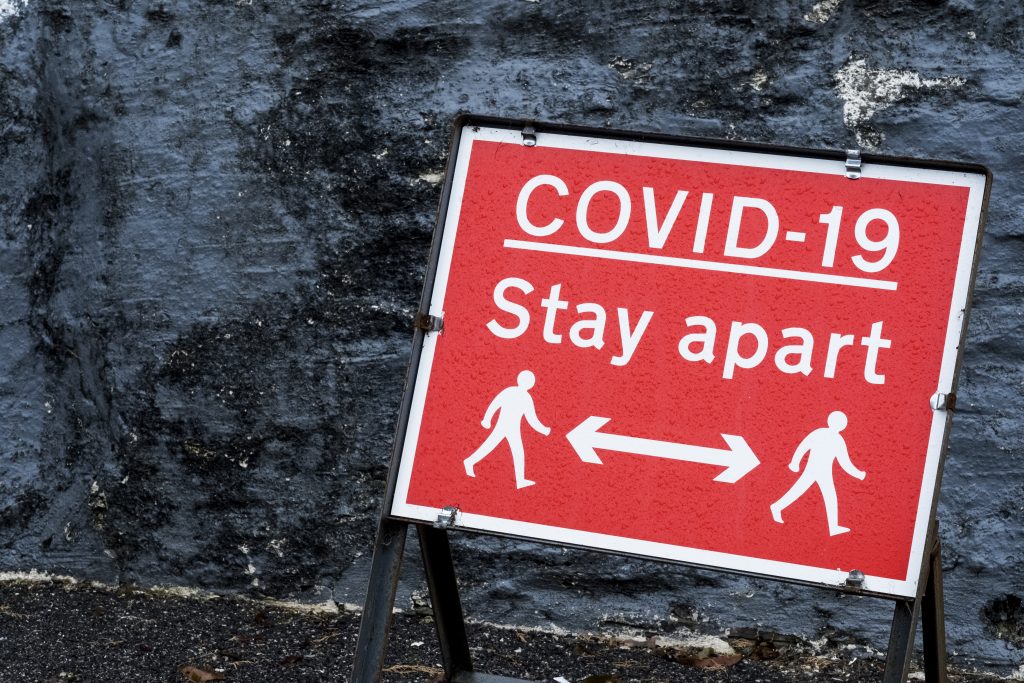
#3 Keep 2 Metres Distance
At all times during the call out, the electrician will need to keep a distance of 2 metres. In Scotland and throughout the UK this is the recommended social distancing guideline.
Ideally, the electrician would prefer there to be no or as little face to face contact as possible, this is why they will have a more thorough understanding of your circumstances from the initial phone consultation.
According to the analysis published in The Lancet, modelling suggests for every extra metre further away up to three metres, the risk of infection or transmission may halve.
Therefore, on initial contact, the electrician will ring the bell and step a full 2 metres distance away, with no handshaking. For indoor electrical work, please ensure to keep out of the room whilst the electrician is carrying out repairs and, as previously mentioned, please don’t offer any refreshments.
This might all seem a bit antisocial, however it is important from a safety perspective to enforce the guidelines set out wherever possible.
Related Content – Working From Home – 5 Electrical Mistakes People make when setting up a Home Office
#4 Hygiene & PPE
The use of face coverings is advised when working within a confined space, as explained in the Scottish Government Coronavirus (COVID-19) Guidelines (published 11th May 2020)
“By face coverings we do not mean the wearing of a surgical or other medical grade mask but a facial covering of the mouth and nose, that is made of cloth or other textiles and through which you can breathe, for example a scarf”
As the Government has requested the public to keep the supply of disposable medical face masks as a priority for the NHS and Care Home sector, you can expect your electrician to wear a cloth type mask whilst working indoors in an enclosed space.
Although, disposable gloves may appear like they are an essential part of PPE, contact transmission from touching a contaminated area, then touching the face, is the virus route of transmission. The wearing of disposable gloves will not prevent this from happening, therefore it is unlikely you will see your electrician wearing disposable gloves as part of their protective PPE.
Hand washing is of utmost importance, and will be carried out by your electrician frequently, where hand washing facilities are not available this will be replaced with the use of hand sanitiser products.
#5 No Cash Payments Accepted
Cash is notorious for carrying germs.
To keep transmission routes to a minimum, you will find that most electricians will forward you an invoice once the work is completed and payment can be made via bank transfer. You may find that some ask for an upfront deposit payment for materials, so it is best to ask them for payment terms during your phone consultation.
back to all blogs